Notion changed how it charges. Two of the new roles say so out loud.
Four new go-to-market roles, and the reason is a pricing decision from May. What a consumption motion actually asks of the people running it, and the measurement nobody has specified.
Late in August 2026, Notion announced it was rebuilding go-to-market around a workflow-first, builder-led model. Most of the hiring had already happened. The bulk of the Solutions Consultant requisitions went up on 27 July and most of the Outcomes Architects on 28 and 29 July, a month before the announcement, and a Forward Deployed Engineer, GTM has been open since August 2025. The Solutions Consultant owns the account from the first meeting through workflow design and into the build.
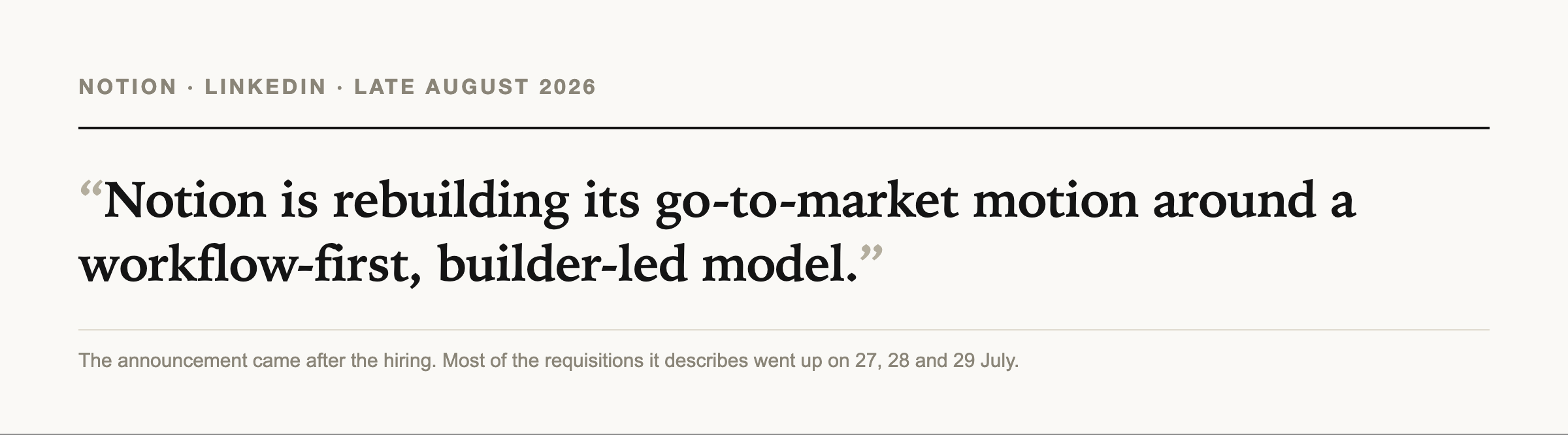
There is no blog post behind it. No press release, no strategy document, no analyst coverage. I went looking. What exists is a set of job postings and a LinkedIn announcement, which makes the roles themselves the primary source.
That is fine. A requisition has a salary band and a quota expectation attached to it, and somebody had to approve it. A press release does not and nobody did.
What it actually is
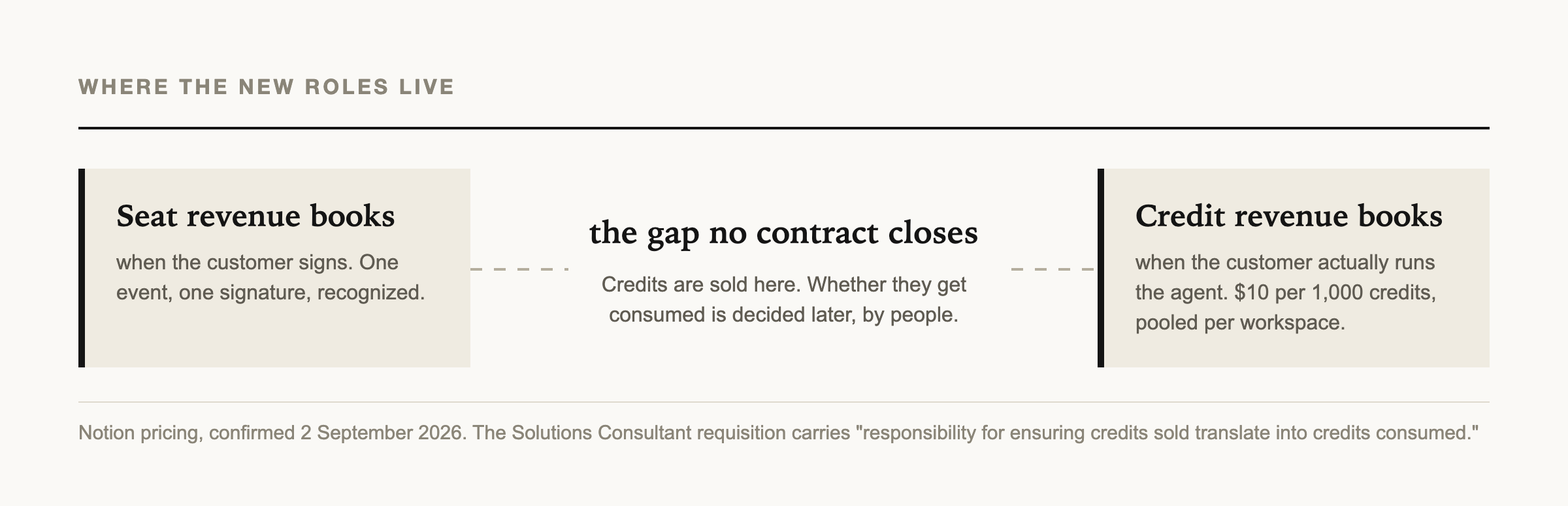
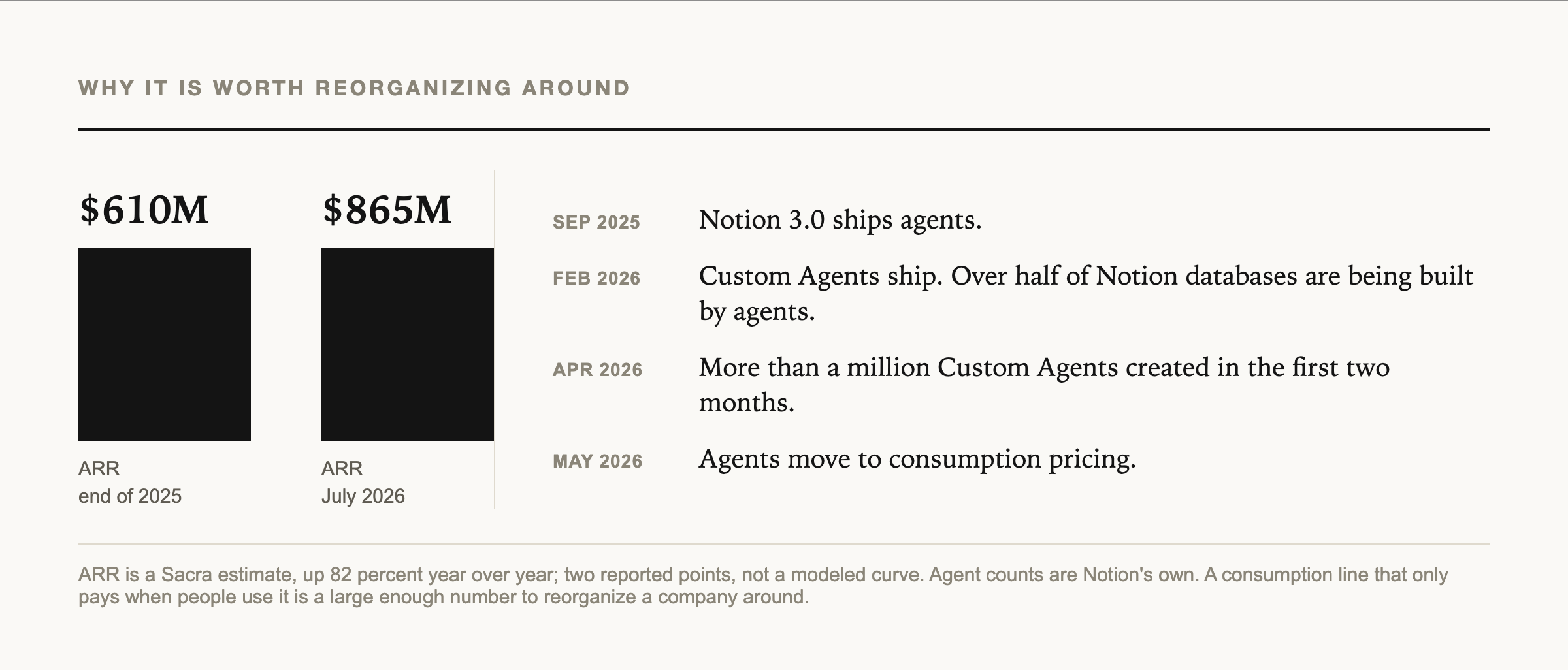
On May 4, 2026, Notion moved Custom Agents to consumption pricing. Ten dollars per thousand Notion Credits, pooled at the workspace level, Business and Enterprise plans only. When a workspace runs out of credits, its agents pause until the credits reset or an admin buys more.
That one change explains what two of these requisitions ask for. The Solutions Consultant is made responsible for ensuring credits sold translate into credits consumed. The Outcomes Architect is asked to build workflows that drive usage-based consumption. Neither sentence would have been written under seat pricing. The dates are looser than the language. Notion has been hiring forward-deployed people since August 2025, well before any of this, so the pricing change explains what the newer requisitions say rather than the existence of the function.
Seat revenue books when a customer signs. Credit revenue books when a customer actually runs the agent. Between those two events sits a gap that no contract closes, and the two new titles live in the gap.
The comp function says the same thing out loud. In July, Notion’s global sales compensation partner Brian Le described rebuilding plans around selling efficiency, and said the product-led and sales-assisted organizations had been running as two very separate business units that are now being unified.
Notion already had an enterprise motion. What it did not have was a way to staff against usage after the signature, which is the Snowflake and Databricks pattern. Land the account, then put humans behind the meter.
The product numbers make it urgent. Notion 3.0 shipped agents in September 2025. Custom Agents followed in February 2026, and more than a million were created in the first two months. Ivan Zhao said in a February interview that over fifty percent of Notion databases are being built by agents. Against roughly $865 million in ARR growing 82 percent, a consumption line that only pays when people use it is a large enough number to reorganize a company around.
The tell is in the quota
The Enterprise Solutions Consultant pays $306,000 to $390,000 on target in San Francisco. Mid-Market pays $216,000 to $276,000 and Commercial $180,000 to $216,000. All three carry the same credits-consumed responsibility and all three ask for a track record of exceeding quota.
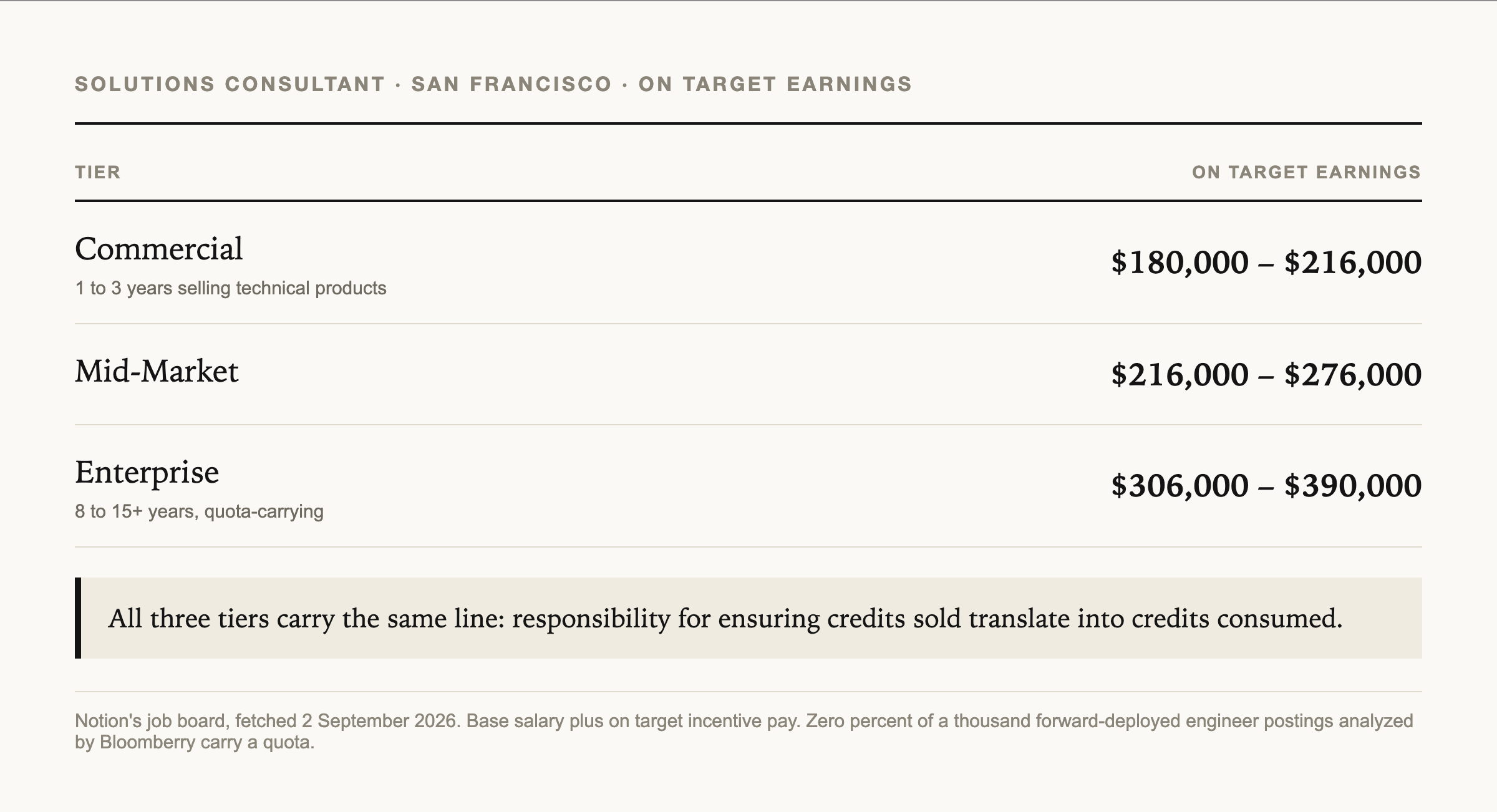
At Notion this is a sales role with a technical bar, paid on target earnings with incentive pay, on a ladder that runs from a hundred and eighty thousand to three hundred and ninety.
For contrast, Bloomberry’s analysis of a thousand forward-deployed engineer postings across the industry found a median salary of $173,816, equity mentioned in seventy percent of them, and zero percent carrying a quota. Those are different jobs with different incentive structures. Notion has posted both under one banner.
The structural change is the one to watch. Notion has collapsed the account executive and sales engineer split. One person runs discovery, designs the solution, and closes. Google Cloud and Salesforce have both built forward-deployed functions of their own, so the function is not what makes Notion unusual. Collapsing the split is.
The thing the literature says not to do
Notion’s posting is titled Forward Deployed Engineer, GTM. That role predates the pricing change, so what follows is about org design rather than about credits.
In February, F-Prime Capital published a warning about where this function reports. Paying forward-deployed engineers on closed deals, they argue, makes them optimize for immediacy, and custom solutions multiply. Their recommendation is a dual reporting line into customer engineering with a dotted line to product. They also give a number. If more than thirty to forty percent of deployments require significant forward-deployed effort, the problem is product design.
Notion has done the exact thing.
There is a real counterargument. If customers buy outcomes now, then deep customization is the product. Notion has acted like it believes that internally. In a December 2025 account it embedded an engineer inside its own sales organization for a month to build tooling from the inside, on the theory that you cannot see the workflow problem from outside the room. That was its own room rather than a customer’s, which is worth saying, because it makes the experiment cheaper than the argument needs.
The criticism and the counterargument make the same prediction about what to measure, which is the useful part.
Who wrote the measurement
Every one of these roles is sold on an outcome.
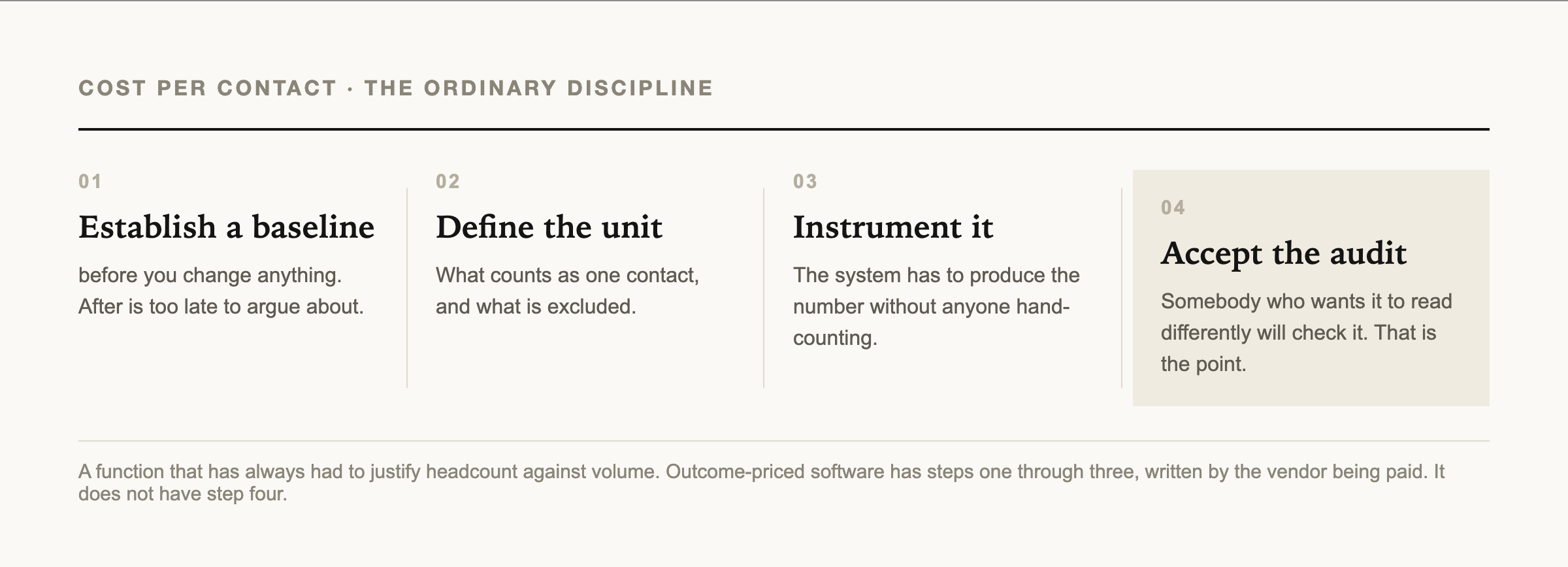
Support operations has argued about the general version of this for a long time and calls it cost per contact. It has never fully standardized it either, which is closer to the point than a settled definition would be. You establish a baseline before you change anything, you define the unit, you instrument the system to count it, and you accept that the number will be audited by someone who wants it to read differently. It is the ordinary discipline of a function that has always had to justify headcount against volume.
The discipline has been written down for outcome-priced software too. Zendesk put out a version of it in April 2026. It names a starting baseline, a measurement period, the exclusions that decide whether an outcome counts, instrumentation through product logs and APIs, shared dashboards, and a validation process meant to settle discrepancies before they turn into billing disputes. Deloitte published on the accounting treatment in June. The spec exists.
Zendesk defines what a resolution is, Zendesk instruments it, Zendesk runs the dashboard the customer reconciles against, and Zendesk bills $1.50 per automated resolution. In May it added tiers, so a contained conversation is free and only a verified resolution bills, with an LLM reading the transcript to decide which one happened. The verifier belongs to Zendesk. Cost per contact ran the other way, an internal number owned by the person it was used against, which is why it had to survive an audit.
Buyers have started writing back. The advice circulating now is to demand the confirmed-versus-assumed split every month, on the reasoning that a vendor confident in its assumed resolutions will not mind showing you the ratio. Intercom’s Fin counts a resolution as confirmed when the customer says it helped, and assumed when the customer simply stops replying. A customer who gave up as futile and a customer who was actually helped both stop replying.
That advice is contract-stage. It tells you what to get in writing before you sign, and it stops there. None of it produces somebody outside the contract who gets to look at the number afterwards.
Advertising built its referee while Congress was still holding hearings into how audiences were being measured. The Media Rating Council dates from the early sixties, it accredits measurement products through independent audit, and it was extended to digital advertising about forty years after that. Energy performance contracting, where the contractor is paid out of measured savings, runs on a published protocol with a defined baseline period and rules for adjusting the number when something other than the retrofit moves it. Contact centers have COPC, Inc., which at least publishes the standard and the audit, though the body that wrote it also sells the consulting.
Outcome-priced AI has none of that. The spec exists, the vendor wrote it, and there is no third party in the room.
The other gap is org design. Notion now posts Forward Deployed Engineer, Forward Deployed Architect, Outcomes Architect and Solutions Consultant. Four titles sitting after the signature, and no Customer Success Manager anywhere on the board. There is no published operating model for who owns the customer when the workflow breaks at two in the morning, and no account of what the customer’s own operations team inherits when the engagement ends.
Those two gaps are one gap. If you cannot measure the outcome you cannot say who is accountable for it, and four post-sale titles is what that looks like on an org chart.
The questions
I would ask Notion these. I would ask them of any company announcing this motion.
What share of quota is consumption versus bookings? A company that means it has moved most of the number.
What is current credit utilization against credits sold? This is the metric the whole reorganization exists to move, so someone knows it.
Who owns the customer at renewal, between the Solutions Consultant, the Outcomes Architect and the Forward Deployed Engineer? Ambiguity there means the number is unowned.
What percentage of deployments currently require forward-deployed effort, and what share of that code has merged into the main product repo? Those two together separate a product company from a consulting firm, and both are knowable today.
What breaks in a workspace that makes agents fail? If it is permissions, structure and data hygiene, that is a services problem and the four roles are correct. If it is the product, the four roles are an expensive patch.
The one I would answer myself
Four of those five are Notion’s to answer. The third one is mine, because I have sat on the wrong end of it.
I have owned the staffing plan against the volume coming in, with more headcount gated on bringing handle time down. Two things moved the number. One of them was mine. The other needed a system fixed that I could not change without filing a ticket and waiting behind everyone else who had filed one. That is survivable while somebody is working the half you cannot reach. What wears on you is watching the resources not go there.
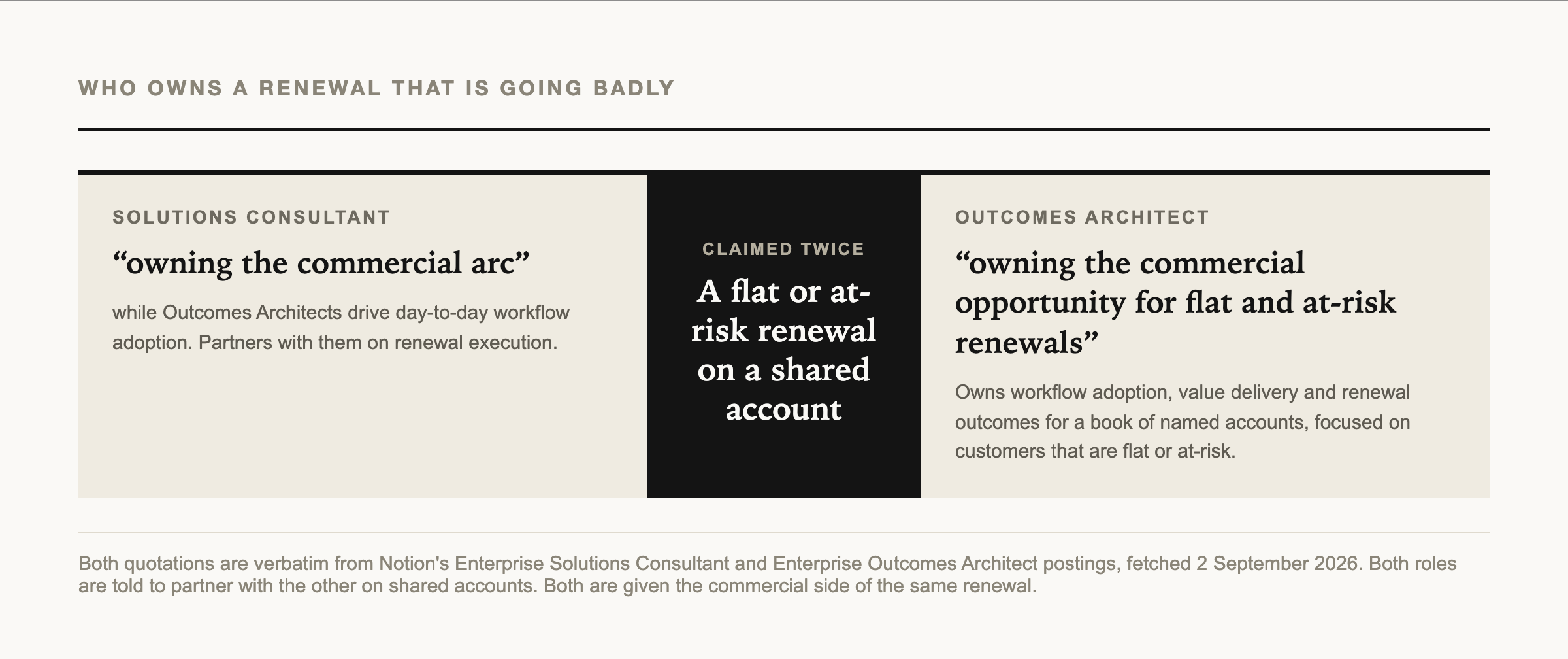
Renewal ownership is that same asymmetry moved one table over. The customer carries the outcome, the vendor owns the instrument that says whether the outcome happened, and the work that would move the number sits on the vendor’s side. Notion’s own postings already show the seam. The Solutions Consultant owns the commercial arc, the Outcomes Architect owns renewal outcomes, and on a shared account both of them own the renewal.
Every number in this piece I checked myself. I counted the roles, I read the salary bands, I pulled the dates the requisitions went up. The one number that decides whether any of this worked, whether the credits sold turned into credits consumed, is the one a customer has to take Notion’s word for.
Researched 2026-08-31 from Notion’s job postings, its May 2026 pricing documentation, published interviews with Notion leadership, and industry writing on forward-deployed engineering. Notion’s open roles were counted from its careers page on 2026-08-31 and came to 137, on 2026-09-01 and came to 133, and on 2026-09-02 and came to 134. A go-to-market share depends on where you draw the line, and I have not drawn it precisely enough to publish one.
Sources
Every number above is checkable. Where I could only see a title and a date, the text says so rather than characterizing what I had not read.
Notion. Open roles and requisition dates counted from notion.com/careers and its job board at jobs.ashbyhq.com/notion, fetched 2 September 2026. Credit pricing from notion.com/pricing. Agent ship dates from Notion’s own release notes. The million-agent figure and the database share are Notion’s self-reported numbers. ARR is a Sacra estimate, not a company figure.
Outcome pricing. Zendesk’s framework and its $1.50 per automated resolution, plus the May 2026 resolution tiers and the LLM verifier, from Zendesk’s own documentation. Intercom’s confirmed and assumed resolution definitions from Fin’s help center. Deloitte’s accounting treatment, June 2026. The honest account of what remains unsettled is The Pricing Conundrum, 9 June 2026.
Forward-deployed engineering. The thousand-posting salary and quota analysis is Bloomberry, November 2025, updated January 2026. The reporting-line argument and the thirty to forty percent diagnostic are F-Prime Capital, February 2026. The embedded-engineer account is First Round Review, December 2025.
Measurement bodies. The Media Rating Council, the IPMVP protocol published by the Efficiency Valuation Organization, and COPC, Inc.. Each is described only at the level stated here. I have not audited any of them.